It's a man thing: the trouble with Tomb Raider
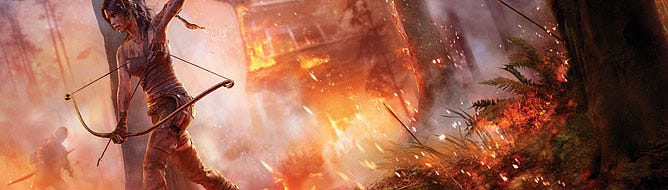

Don't miss the point, says Patrick Garratt. The travails surrounding Lara’s reinvention are to do with triple-A's obsession with men and violence, not women and sex.

That "chick" movies like Bridget Jones and Love Actually exist is fine, because every other genre is represented in film. In triple-A games there's nothing apart from hardboiled action designed to appeal to men. And that's why Tomb Raider is the way it is. None of this is really about Lara Croft.
This article contains discussion of violence, including sexual violence.
Poor Lara. In the past few weeks she's fallen on a metal spike, seen a friend crucified in a catacomb and killed a man after being placed in a situation where she’s apparently going to be raped and murdered. We’ve seen her transform into some kind of super-hunter who thinks little of shooting people in the face with a bow and arrow and entering into combat against fully-automatic weapons. Not content with grinding video gaming’s most prominent female character through this violent mill, Crystal Dynamics has told us she’s some kind of innocent little thing you’ll want to protect rather than “be,” and that the turning point in her journey from kid to killer is an attempted gang rape.
The media's had a field day, despite the chauvinism being swiftly retracted. But what's the real problem here? What we’re seeing in the Tomb Raider reboot is nothing new from a content perspective, so why did we all square up over Lara?
"From thence into beauty"
It can't be over the assault scene itself, which can be termed as "strong" but is certainly nowhere near any BBFC danger-zone. The plot we’ve seen so far, in fact, bears more than a passing similarity to films like Wolf Creek. Here we have pretty young women thrown into a desperate situation with some “bad” men, which, after a build up, arrives at a transformative scene. The fulcrum moment in exploitation horror normally involves some kind of torture event in which the victim is forced to respond with deadly force or die. This is a common device. Its purpose is antagonism, which then becomes the basis for the rest of the narrative.
Tomb Raider's change-point occurs when Lara is captured in some kind of derelict structure close to a campfire by a man with a gun. It seems obvious that unless she fights, she’s going to be raped and killed. There’s a sexual assault, to which she responds by kneeing the man in the bollocks. The man then grabs Lara around the chest and buries his face in her neck. There’s a fight, and the man is shot in the face. Lara is transformed. She is now a murderer, and, splattered with gore from the shooting, picks up the man’s pistol and enters into combat with the rest of the gang.

Spot the difference? While Tomb Raider
draws well back from the severity of
content in some exploitation horror, there's
no denying thematic similarities. Top to
bottom: Tomb Raider, The Last House on
the Left, I Spit on Your Grave, Wolf Creek.
What’s wrong with this? From a broader perspective, nothing at all. If you look at other media we're in well-trodden territory, which explains why the sexual content in the pre-E3 trailer went by largely unnoticed. There was some eye-rolling, but it was no big deal. Brenna flagged it to me in an email as a potential feature, but it got lost somewhere in LA. The real stink didn't emerge until Kotaku published its E3 interview with executive producer Ron Rosenberg. We were told in explicit terms that Lara was to be “literally” depicted as a “cornered animal” in an attempted gang-rape scenario before metamorphosising into her murderous final form.
The type of situation Rosenberg appeared to be describing is more reserved for the very strongest and most controversial horror films, such as I Spit on Your Grave, The Last House on the Left and Irréversible. Explicit sexual violence and "rape revenge” remain, to this day, some of the most contentious fields in media despite being more popularised recently by The Girl with the Dragon Tattoo. Regardless, the whole thing was a red herring. There is no rape - although it’s strongly implied there’s going to be one - and what we appear to be seeing in the later stages of play isn’t “revenge” so much as “survival, rescue and escape”. We don’t know yet, obviously, but it’s clear from Crystal Dynamics' feverish back-peddling that the sexual elements we see in the the transformative scene are incidental. In films like The Last House on the Left, the rape element is explicit and central, and dictates what happens later. In I Spit on Your Grave, for example, the victim eventually cuts off the penis of one of her attackers, shoves it in his mouth and lets him bleed to death. The rape sequences are prolonged and graphic. It's a savagely violent, wholly exploitative exploration of mental abuse, sexual depravity and torture. It's hard to watch in a way Tomb Raider will never be.
But, nevertheless, the new Tomb Raider shares a great deal of common ground with exploitation horror on a thematic level. If a movie was to be made of this, it would be Wolf Creek as opposed to Indiana Jones.
That’s part of the problem. As New Statesman dep ed Helen Lewis said in a VG247 chat on the matter recently, the argument isn’t about whether or not the concepts of rape (implied or not), sexual assault and serial murder can be used in fiction as plot devices. Superficially, what’s raising hackles is that this style of content is being applied to this IP specifically, that “this isn’t Lara”.
Thrill kill
Unfortunately, this type of modernisation is unavoidable. Given the reality of triple-A publishing today, Tomb Raider, as it was, is dead. As was clear from this year’s E3, gaming's top flight is now 18-rated with several plusses. Products in this category universally contain very high levels of violence. In this regard, Tomb Raider is in line with Assassin’s Creed, Splinter Cell, The Last of Us, Dishonored, Black Ops II, and all the rest.
In the gameplay footage we saw in the Microsoft press conference, Crystal started with Lara shooting a man in the back with a bow and arrow, before spiking another in the side of his face and pushing someone else to his death from the top of a cliff. After a conversation with her captured friend by radio, she set two men on fire before wounding an enemy’s leg then killing him with an arrow to the chest. She burnt more men, used a shotgun on others, then dispatched another goon, who was distracted by reloading a rifle, by stabbing him through his throat with an arrow. In a little over two minutes, she murdered 11 men. The sequence ended with her parachuting through a forest to eventually fall through a tree’s branches, in a scene which shared distinct similarities with one of Rambo’s more famous sequences.
Sounds mental? Of course it isn’t. Watch the Splinter Cell: Blacklist footage from from the same conference; Sam Fisher kills 26 people (I think: it’s quite hard to keep track) in just over six minutes. “Execute ready” flashes on the screen several times. We’re told that Ubisoft Toronto has perfected a system of “killing in motion”. It's incredibly violent, but Sam's saving the world from the evil terrorists, so he can do whatever he likes.
In truth, Tomb Raider shines a light on the violence levels we've come to accept in modern, premium video games by swapping out the traditional male protagonist for a woman and switching the setting from military (or magic, or sci-fi) to civilian. The reason there’s been a backlash against the “ultra-violence” on display at E3 is that triple-A's new wave involves everyday people in exceptional circumstances. We've entered the realm of hyper-violent contemporary fantasy. Watching a soldier stab a man in the neck is acceptable; transfer the same action to a 21 year-old girl and it's just confusing unless you engineer a suitable situation.

The Bechdel Test. Apply this to games for fun
and incredulity.
Tomb Raider’s perception issue stems directly from this. Any serious video game in 2012 needs to rely heavily on combat. Modern triple-A is about creating a scenario in which the protagonist is free - and positivity required - to behave in the most violent way possible. Triple-A is, in fact, a giant combat simulation.
Square had to create a back-story in which Lara is forced to transform from a student to a mass killer in a realistic scenario. And so we have the movie horror plot, in which Lara, beyond any help, must kill to survive. The word “lazy” has been levelled at Tomb Raider over the sexual elements, but I don’t buy that. I have no doubt that years of thought and plotting has gone into the narrative of this game, and by committee there’s been a decision that Lara must enter and exit a transformatively violent event. Horror scenarios such as this, involving young women and male aggressors, invariably contain some kind of sexual element. Whether or not that’s right or wrong is moot, and you have every right to be p**sed off about it from a sexism standpoint. It doesn’t have to be this way. But, as we’ve shown, we see this type of plotting in film even in the mainstream. From a creativity standpoint, it’s fine.
The Smurfette Principal
The real reason behind any annoyance surrounding Tomb Raider is that so few prominent video games contain female protagonists. Lara's a poster girl, so seeing her treated in this way is seeing all women in games treated in this way. There's a really simple reason why this is happening. As the Guardian's Mary Hamilton mentioned in our liveblog on the matter, female characters in games can easily be seen in the same sphere as the “Smurfette Principal”. In brief, the 60s cartoon of the Smurfs got a girl. She was called Smurfette. She was the only female in a village of 100 Smurfs. Katha Pollitt, writing in the New York Times, summed up her inclusion in the show as “a group of male buddies... accented by a lone female, stereotypically defined."
Lara is Smurfette, not just in Tomb Raider, but in the entire field of triple-A. She’s there to accentuate male characteristics and stereotypical themes rather than to be truly representative of femininity.
The Smurfs was made for boys. Lara is Smurfette, not just in Tomb Raider, but in the entire field of triple-A. She’s there to accentuate male characteristics and stereotypical themes rather than to be truly representative of femininity. The problem is especially bad in games, but exists in other media. An easy way of showing just how sexist movies can be, for example, is to look at the Bechdel Test. To pass, a film must feature at least two named women who talk to each other about something besides a man. I'm sure it won't surprise you to know that many films fail. Apply this to big budget games and see what happens.
While we don’t know yet if Tomb Raider would pass, it's obvious it's a game about a woman made for men. Triple-A, without exception, is aimed at the male audience. When you couple this with the fact that the triple-A market dictates Lara must behave in a phenomenally violent way, it's not difficult to see how Crystal Dynamics arrived at the game unfolding before us today. Psycho-Lara has to come from somewhere. And the fact that psycho-Lara has to come from anywhere at all is down to the demographic the product's aimed at.
Think about it this way. Imagine if all blockbuster movies were rom coms specifically targeted at women, that every major film release was a variation on Bridget Jones's Diary or Love Actually. Imagine that every male character in the entire medium was a smouldering do-gooder driven by love, or a plummy cad to be biffed in a fight over honour. There'd be nothing to describe other aspects of masculinity, so film as a medium would be sexist in the way it displayed men.
That "chick" movies like Bridget Jones and Love Actually exist is fine, because every other genre is represented in film. In triple-A games there's nothing apart from hardboiled action designed to appeal to men. And that's why Tomb Raider is the way it is.
None of this is really about Lara Croft, and it would be ludicrous to level blame at Crystal Dynamics and Square Enix over video gaming's love affair with men. The whole “rape” embarrassment was just an everyday PR f**k-up. The point here is that triple-A games are inherently sexist in their treatment of women because it’s an industry aimed almost exclusively at the male sex. This is a bad thing. Creatively, these products will not be made with women in mind until the medium and the business surrounding it are capable of delivering a broad range of plotting and believable, human characters, both male and female. Games won't become significantly more inclusive until big budget productions break away from extreme violence as the only core gameplay mechanic; we're unlikely to be seeing that happen any time soon.
Until it does, don’t be surprised to see female characters treated like this in triple-A, if you see them there at all. It's not Lara's fault: it's a man thing.