Tag Archives: metacritic
Fri, Nov 18, 2011 | 15:19 GMT
Jurassic Park: The Game developers post glowing user reviews on Metacritic
Telltale employees have posted user reviews for Jurassic Park: The Game on Metacritic, and while such a thing isn’t a new occurrence, it sparked a bit of a red flag with Gamespot when it noticed four 10/10 reviews going up during the same time frame.
Thu, Jul 14, 2011 | 15:55 BST
MetaCritic co-founder admits removal of games site due to “corrupt practices”
Metacritic co-founder Marc Doyle has said the aggregation site has had to remove a games publication from its reviews list due to “corrupt practices”.
Tue, Jul 12, 2011 | 12:42 BST
MetaCritic co-founder says game ratings are unbalanced
MetaCritic co-founder Marc Doyle has admitted that ratings for games on the website are unbalanced.
Wed, Apr 20, 2011 | 14:45 BST
Portal 2 fan backlash on Metacritic
Customers unhappy with day one DLC and complaints of console-related messages in the PC build have driven down the Portal 2′s Metacritic user rating.
Thu, Mar 31, 2011 | 18:38 BST
Metacritic ditches plans to assign scores to developers
Metacritic announced earlier this week it was suspending developer ratings on the site, but it has since decided to forgo individual developer ratings altogether.
Tue, Mar 29, 2011 | 07:30 BST
Metacritic disables dev aggregate score program
There’s an old saying about “the best laid schemes of mice and men.”
We’re guessing it’d probably average, oh, about an 85.
Sat, Mar 26, 2011 | 18:14 GMT
Metacritic starts posting aggregate scores for developers
Metacritic has started rating individual developers via a profile page which includes an aggregate score for credited work.
Tue, Mar 15, 2011 | 23:30 GMT
Metacritic adds iOS section
The slow-turning weathervane of the industry, Metacritic, has added a category for iOS games to its line up.
Wed, Mar 09, 2011 | 22:30 GMT
Zelnick: Metacritic ratings vital, “good is the new bad”
Take Two CEO Strauss Zelnick has said Metacritic ratings, and the reviews they’re based on, make a “real difference” to the game’s success – or failure.
Thu, Feb 10, 2011 | 08:54 GMT
MetaCritic: Take-Two highest-scoring publisher in 2010
MetaCritic has announced that Take-Two was the highest-scoring games publisher in 2010.
Sat, Sep 11, 2010 | 18:31 BST
Metacritic – Game Informer gives Halo: Reach a 95

Game Informer has given Halo: Reach its first review score, according to Metacritic, handing the Bungie shooter a 95/100.
Sun, Jul 04, 2010 | 20:18 BST
Mid-year Metacritic report shows increase in top-scoring games

MetaCritic has released its half-yearly report, showing an increase in review scores for the period, despite NPD reporting sales are down when compared to the same six months last year.
Thu, Dec 10, 2009 | 21:19 GMT
PS3 tops Metacritic’s first annual Game Platform Power Rankings

PS3 has beaten out PC, Wii and Xbox 360 to finish on top of Metacritic’s first annual Game Platform Power Rankings.
With five games included in the top 10 for the year, PS3 titles garnered an average Metascore of 72, with only 7 percent of titles created for the console garnering a “bad” score.
In comparison, Xbox 360 which came in third behind PC, its games averaged a Metascore of 70 percent, with 11 percent scoring badly with 51 more games released for the year than PS3. Seven of these games received a “great” ranking, while 10 on PS3 received the “great” rating.
While PS3 came out on top, followed by PC and then Xbox 360 – PSP came in fourth, followed by DS and Wii respectively.
Full thing through the link.
Via PushSquare.
Wed, Nov 25, 2009 | 20:01 GMT
Analyst: Reviews are the “least important factor” to gamers

A Cowen Group survey has revealed that game reviews are the “least important factor” to consumers when deciding on which title to purchase.
Instead, according to analyst Doug Creutz, gamers rely mainly on word of mouth and publishers should stop focusing on scoring a high review.
“We believe that while Metacritic scores may be correlated to game quality and word of mouth, and thus somewhat predictive of title performance, they are unlikely in and of themselves to drive or undermine the success of a game.
“We note this, in part, because of persistent rumors that some game developers have been jawboning game reviewers into giving their games higher critical review scores. We believe the publishers are better served by spending their time on the development process than by grade-grubbing after the fact.”
More through CVG.
Wed, Jun 10, 2009 | 16:04 BST
Peter Moore says user reviews more relevant than Metacritic

Peter Moore says that user reviews pertaining to Wii titles are more relevant that Metacritic because titles that get a 70 can still sell millions of copies.
Speaking with Gamasutra, Moore said that when it comes to EA Sports Active, “We’re not going to Kotaku or Operation Sports on this one, we’re going to Amazon.”
“The thing is with the Wii, it seems to be for the gaming sites, it’s the last platform they review,” he continued. “It takes a time to get an actual review score. I would pretty much guarantee that just about every Wii game ships without a Metacritic rating because [reviewers] haven’t got around, to it or they’re not interested in reviewing it.
“I absolutely guarantee you, the thing we’re watching most closely now [with Wii titles] is things like Amazon – and I’ll go look at women’s magazines that have powerful websites, and then we look at what we call ‘mommy bloggers’.
“That’s where those people go for their information. They are not going to Metacritic. They don’t know Metacritic exists.”
More through the link.
Tue, Apr 07, 2009 | 20:37 BST
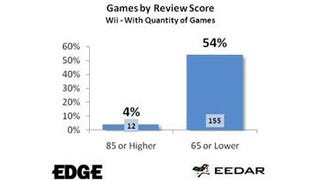
Official: Wii games are rubbish

Edge has posted its final format-specific review score graph thing, this one showing categorically that the vast amount of Wii’s games are pretty much terrible.
From Wii’s launch to the end of last year, four percent of the platform’s games have rated over 85 percent on Metacritic. That’s 12 games.
Fifty-four percent, or 155 titles, have rated below 65 percent.
We don’t really need to say anything else. Read loads more words on the matter through the link, should you need to.
Wed, Mar 18, 2009 | 18:41 GMT
GameQuarry declares Visual Concepts “most consistent” developer

GameQuarry is back, and instead of using Metacritic data to figure out consistency in publishers this time around, developers are under the microscope.
Scores were given a letter rating. A: 90 percent or higher (2 points), B: 80-89 percent (1 point), C:70-79 percent (0 points), D: 60-69 (-1 point) and F: 59 percent or lower (-2 points). Just like school.
At the top of the list of 1,700 companies? Visual Concepts, the Take-Two studio responsible for loads of 2K Sports titles, with grand total of 45 points. Ten of it’s games got an A, 40 were ranked B, 11 got C’s, 7 were given D’s and 4 were given an F.
The top twenty list is as follows:
- Visual Concepts
- EA Tiburon
- Nintendo
- EA Sports
- Neversoft Entertainment
- Konami Tokyo
- Harmonix
- Sports Interactive
- Intelligent Systems
- Valve
- Rockstar North
- BioWare
- EA Canada
- Criterion
- Bethesda Softworks
- Raven Software
- Firaxis
- Insomniac Games
- Infinity Ward
- Epic Games
Thu, Mar 05, 2009 | 17:53 GMT
GameQuarry declares Ubisoft to be “least consistent” publisher

GameQuarry has published a list of the most and least consistent publishers according to review scores. Rockstar is at the top, Ubisoft at the bottom.
The research firm assigned points to each scoring bracket in the Metacritic system. Two points were awarded for games in the 90-100 bracket, 1 point for 80-89, zero for 70-79, -1 for 60-69 and -2 points for anything with a Metacritic average of 59 or below.
Rockstar received a total of 19 points from 23 titles and Ubisoft received the lowest, with -148 points from a total of 237 games.
“Using this method, publishers who may have created stellar titles, would also be penalized for each low scoring game and given no credit for average games,” wrote the report’s author.
Dave Perry wrote on his blog that this data may provide an interesting argument over the validity of using Metacritic data in the industry.
“This is based on Metacritic data, and let’s just say many of my friends are having a VERY heavy discussion (right now), on the validity of the Metacritic data. (So this is incredibly timely and will add fuel to that fire for certain!)”
The report author did note that the data does not “reflect trends towards an increase or decrease in quality trends”.
A consistent publisher may be may in fact be trending towards a decline in quality whereas a publisher on the Least Consistent List may “trend towards an increase in quality”.
More through the links.
Fri, Jan 30, 2009 | 16:37 GMT
Metacritic helps business objectivity, says Sega’s Hayes
In response to Splash Damage studio director Paul Wedgwood’s claims that Metacritic pressure on devs was “ridiculous,” Sega Europe president Mike Hayes said that reckons Metacritic provides “objectivity into the business.”
Hayes added the caveat that the meta-review site needs to be used sensibly, however, if factored into future developer deals.
“The first thing is that we’re always trying to put objectivity into the business,” he told GI. “We’re a creative business, and how do you put objectivity into it?
“But at the end of the day publishers will always want to do that, particularly if you’re spending USD 20 million – you have to try and find that objectivity, and it’s going to come from how much it costs, when it’s coming out, and how good the game is.
“I don’t think you can get away from that, and Metacritic provides a service that gives you a part of that,” he explained.
“If you’re going for a high-end PlayStation 3 or Xbox 360 game and you want to break out in the genre, or something like that, you have to target that quality – because otherwise you don’t have a hope in Hell,” he went on.
“There’s too much evidence that shows games which score below a certain level in certain genres are not going to cut through.
“However, there are other genres and other platforms where we wouldn’t put a developer against that score, because it’s more about the brand, the license, the release timing – it’s probably something that in the Metacritic basket of reviews, they’re not going to look at the same things that we’re going to look for when making a game,” Hayes continued.
“So when we’re doing developer contracts, we won’t say to every developer we work with that there’s a target in there. But where we’re spending a lot of money, and the score is essential to the success of the product, absolutely I think there’s a value in it.
“We value the scores that we’re given by the media – it’s a very good way of measuring it – and I don’t think it’s unreasonable for publishers spending that much money to have certain expectations of quality levels. But to demand it on absolutely everything wouldn’t be right at all.”
By Mike Bowden
Tue, Jan 20, 2009 | 08:25 GMT
MetaCritic pressure on devs is “ridiculous,” says Splash Damage boss
Splash Damage studio director Paul Wedgwood has said that the fact some developers’ bonuses are dependent on a MetaCritic average is “ridiculous” and he feels the percentage scoring system on games reviews needs to be looked at.
“Personally I think it’s ridiculous,” Wedgwood told GI when asked about an instance where a dev team was require to get 9′s rather than 8′s.
“In the film industry, four stars is an amazing score. I think it’s a really good idea for a developer to go to a publisher and demand that they get an additional bonus for achieving a certain review score, but it shouldn’t affect their royalties or anything else. If you have a high-selling game, you have a high-selling game.
“We know that some websites score quite high and some quite low, but in general, all websites tend to score between 60 and 100. There’s never a 37. It’s as if that whole section doesn’t exist, so zero starts at 60, so three stars, and goes up to five. It’s just not really an accurate enough measure.
“I think that if anything, the games press should take the pressure off themselves, and just go across to star ratings, which for films is nothing more than a recommendation that you buy it, watch it when you get the chance, or rush out and see it straight away, and it’s your personal recommendation,” suggested Wedgwood. ”
It’s not a ‘score’. If that was all you did, nobody would hate you guys for it.
“Out of ten is a good start,” he went on. “Percentiles put too much pressure on a journalist to justify an exact score. It puts too much pressure on the developer to try and identify these criteria that lead to very specific point increases or decreases, which is not at all what the developer should be focusing on.”
More through the link.
By Mike Bowden


Mass Effect 3 Take Earth Back trailer teased